Top 5 Indications That You Have a Bat Infestation

Louisville Bat Removal and Control 502-553-7622

Louisville Bat Removal and Control 502-553-7622

One of the most incredibly fascinating facts about bats is that they are the only mammals on Earth that can actually fly! Unfortunately, this gift of flight is what gives them easy access to residential and commercial real estate. This time of year, bats are searching for warm shelters to roost and hibernate for the winter. Common target areas include high-up places, like attics and roofs, where bats can make a safe, warm home for the season.

Why are Bat Infestations a Big Deal?

First, bat species that are native in the Kentucky region are not solitary mammals. This means they come in large quantities. Now combine a large colony of bats with the type of destruction they cause, and you instantly have a costly and frustrating situation on your hands. You see, once bats get inside, their natural behaviors of feeding, breeding, and nesting, negatively impacts the overall value and structural integrity of a property.

The longer a bat infestation goes unnoticed, the more damage they do. Their droppings will saturate and soil everything it comes into contact with, and even start to seep into walls and ceilings, and lead to foul, lingering odors. Sheet rock, ceilings, dry wall, insulation, roof shingles, siding, and more can also be damaged by bat infestations and nesting.

How to Look for Signs of Nuisance Bat Activity

If you suspect that you have a bat problem, contact a licensed Louisville bat removal and control company for prompt and professional wildlife abatement services. If you are not sure whether or not you have bats around, do a brief inspection of your property to look for the common signs of a bat infestation. Here’s what to look for:

🔎 Strange Noises

Bats are nocturnal, so you will not be very successful listening for noises at night. This is when they leave their roosts and hunt for insects. Instead, do your investigating during the early morning hours when they are returning to their roosts. Listen carefully to the walls, ceilings, and attics for odd noises of activity. Bat noises generally sound like fluttering, squeaking, screeching, chattering, and shuffling.

🔎 Guano Accumulation

Aside from actually seeing bats, the most distinct indication of a bat infestation is finding accumulations of bat droppings, also known as guano. You may see mouse-like droppings around window sills and eaves, since bats like to perch in these areas when coming and going from their roosts. You may also find piles of guano in the attic, crawl space, or garage areas. Bat guano is similar to rodent droppings, except it is shiny and speckled from digested insect parts.

🔎 Stains and Odors

When bat urine and guano accumulate in large masses within a roost, eventually the odors and liquids will seep into the living areas of the property. Walls and ceilings are common areas where droppings will stain. If you have brown or yellow shaded stains on your ceilings or walls, it is a strong indication of a bat infestation above.

🔎 Milky Liquid on Windows

As mentioned, bats like to perch on window sills and eaves. And in these areas, you might find milky urine stains dripping down the windows. These stains will also be sticky and odorous, and attract other pests, like gnats and flies.

🔎 Stains Around Entry Holes

Bats fur contains a natural oil that can retain dirt, and as a result, leave behind grease-like stains around their entry and exit points. If you see small gaps, openings, or holes with dirty smudges around them, it is very likely that you’ve found a bat roost.

Louisville Bat Removal and Control

Louisville Bat Removal Kentucky

Louisville Bat Removal 502-553-7622

Call 553-502-7622 for prompt and professional bat removal services in Louisville, Kentucky and its surrounding areas. We are DNR licensed bat removal contractors that offer safe and non-lethal, 24 hour bat extraction and exclusion services for residential and commercial properties. We also provide bat cleanup and minor attic restorations for bat damages too. Request a free estimate, anytime.

Learn About Bat Dangers With These FAQS

Although bats are fascinating creatures, and a vital part of our eco-system, they also pose several health and safety risks. If you live in an area where bat activity is regular, or your property is located near woods and a body of water, it is in your best interest to have your home or business animal-proofed to ensure safety and security.

Continue reading to review some frequently asked questions about the dangers surrounding nuisance bats, as well as, how to get started on bat-proofing your property.

Louisville Bat Removal and Control 502-553-7622

Louisville Bat Removal and Control 502-553-7622

Do Bats Have Diseases?

One of the main reasons why bats are a safety and health risk is due to the fact that they are known carriers of several infectious diseases, as well as, pesky parasites like lice, ticks, fleas, and more. The most threatening and dangerous bat disease is Rabies, which is fatal 100% of the time. This is why pet vaccinations are so vital. Furthermore, bat guano can spread fungal spores that can cause serious eye, lung, and respiratory infections; one such condition is called Histoplasmosis.

Do Bats Bite?

Bats are wild animals, and most wild animals will use any means available to them for self-defense. This means that the answer to this question is yes; however, it is not common for a wild bat to attack for no apparent reason. They are generally protecting their young, or they are provoked in some way or another. The best way to avoid a bat bite is to refrain from touching, trapping, harming, or killing a bat under any circumstances. In the case that you endure a bat bite, it is important to call your doctor immediately.

Can Bat Guano Hurt Me?

Bat guano and bat droppings can be unsafe for humans, especially children. In bat guano, a fungus called Histoplasmosis Capsulatum grows and gives off toxic spores that we inhale in the air. Although not contagious, complications from bat guano can be easily and unknowingly contracted through inhaling spores in the air of an infested home or building. One such complication is an infectious lung disease called Histoplasmosis, also known as Spelunker’s Lung, Cave Disease, Ohio Valley Disease, Reticuloendotheliosis, and Darling’s Disease.

Will Bats Damage Property?

Bats will damage a property extensively, and the damage will only continue to accrue as long as the bats reside within the area. Common bat damages include structural damage to attics, crawl spaces, garages, siding, roofs, ceilings, and walls. Additional damages include soiled surfaces from urine and droppings, pest outbreaks (i.e. lice, mites, etc.), and lingering odors. Bat damages must be addressed immediately, otherwise, you will face a plethora of health and safety hazards, and ultimately, a reduction in property value.

What Do I Do If I Find a Bat?

Never under any circumstances attempt to touch, trap, provoke, or harm a bat. Whether you find a bat in your house or stranded on your property, the first step is to contact a local Kentucky Bat Removal and Control Company that provides humane and non-lethal bat abatement services. They can give you instructions on what to do while you wait for them to arrive, or even give you some over-the-phone instruction on how to give them certain information about the situation.

Who Can I Call for 24 Hour Bat Removal and Control in Kentucky?

Louisville Bat Removal Kentucky

Louisville Bat Removal 502-553-7622

Call 502-553-7622 for Louisville bat removal and control you can trust. We are DNR licensed and insured bat control contractors who use safe, non-lethal methods of extraction and exclusion. We serve both residential and commercial clients, and at the most competitive prices in town. Emergency 24 hour service is also available. Request a free estimate, today.

What is Histoplasmosis?

Bats are one of nature’s most fascinating mammals. Not only do bats consume thousands of insects each night, their guano is an effective fertilizer used in multiple industries around the world. With all of these positive characteristics in tow, what exactly makes a wild bat so dangerous to humans and pets? The answer is disease. One of the most implicating diseases a person or pet can catch from having bats nearby is called Histoplasmosis.

Continue reading to learn more about Histoplasmosis, and how to protect your home from bat infestations.

Louisville Bat Removal 502-553-7622

Louisville Bat Removal 502-553-7622

Infectious Bat Diseases

There are various infectious diseases that bats can contract or carry, which are all hazardous to human and pet immune systems. Bats are known to be carriers of the Rabies virus, Leptospirosis, and even Salmonella. All of these infections can be transferred, transmitted, and passed along to humans and pets; and they are all potentially fatal if left untreated.

Bats can also transmit less serious, but equally frustrating, parasitic conditions, such as lice, bat mites, ticks, fleas, and more. Histoplasmosis is a bit different from the infectious diseases just mentioned since it is not directly contracted by a bat. Instead, Histoplasmosis is indirectly spread by bats through by airborne fungal spores that grow on bat droppings, also known as guano.

Histoplasmosis in Detail

Histoplasmosis is referred to by many names, such as: Spelunker’s Lung, Cave Disease, Darling’s Disease, or scientifically, Reticuloendotheliosis. It is an infectious disease that is contracted by over exposure to bat guano. There is a fungus that grows in guano called Histoplasmosis Capsulatum. The inhalation of these spores within the guano causes flu-like symptoms, like coughing and difficulty breathing. It is not a contagious infection but can be easily contracted if precaution is not taken.

Anyone, child or adult, can contract Histoplasmosis. It is rare for just anyone to get the disease because the fungus is only found in dark, warm areas that bat guano is found. So the more common people to fall victim to the illness are spelunkers, chimney cleaners, cave miners, and people that frequent attics and crawl spaces often.

Because they work in areas that bats may dwell in, they are at risk to inhaling the infection causing spores and falling ill. It is not typically fatal unless a person has severe and long term health complications, such as the elderly. Otherwise, if treated at the first signs of illness, it is no more dangerous than the common cold. In fact, in most cases, it just goes away on its own.

Do You Have Bats in the Attic?

Louisville Bat Removal Kentucky

Louisville Bat Removal 502-553-7622

Call 502-553-7622 for Louisville bat removal and control you can trust. We are DNR licensed and insured bat control contractors who use safe, non-lethal methods of extraction and exclusion. We serve both residential and commercial clients, and at the most competitive prices in town. Emergency 24 hour service is also available. Request a free estimate, today.

The Benefits of Putting Up a Bat House

Although bats can be quite the nuisance to residential and commercial properties, especially if they get inside, there are times when you might benefit from having them around. Bats are a highly important part of our surrounding eco-system. They serve a vital ecological importance that should be respected and appreciated. For some, having bats nearby is a huge advantage.

Continue reading to learn why bats are so vital to our lands, and some tips on putting up bat houses to attract them to your property.

Louisville Bat Removal and Control 502-553-7622

Louisville Bat Removal and Control 502-553-7622

Bats and the Eco-System

Bats are not solitary mammals; they live their lives in large colonies. As insectivores, bats consume gnats, flies, mosquitos, moths, and more. In just one night, a single bat can consume more than 1,000 insects. Now multiply this by the number of bats in a colony, and you have yourself a natural, cost-free insect control system at your service!

So how does this influence the eco-system?

Well, not only do we get to enjoy pest-free outdoor activities, crops and lands are more protected from pesky insect damage, which helps farmers make more money, which also positively affects the local economies. In addition, insect control at these levels helps to reduce the spread of communicable livestock diseases that are often transmitted through insect and tick bites. And let’s not forget the bat droppings! Bats help fertilize and pollinate our lands as well, which makes our eco-system stronger and healthier.

What You Need to Know About Bat Houses

If your home or property is located on a large piece of land, perhaps near a body of water, you likely have the perfect place to put up a bat house. Not all properties are well-suited for bat activity, so it is important that you follow the recommended tips below in order to prevent costly bat intrusions or risky encounters.

Bat House Tips:

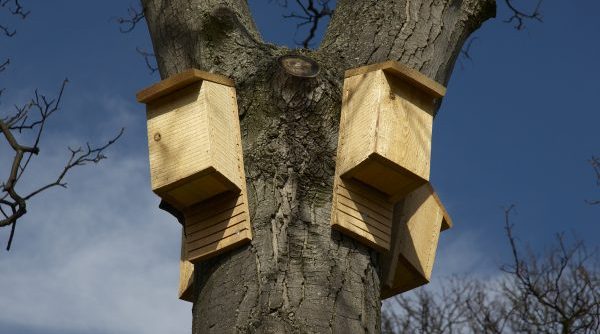
Choose (or construct) a bat house that is a total of 24 inches in height, and contains 2 to 4 chambers. The chambers should be at least 20 inches tall, 14 inches in width, and 1 inch deep, for optimal comfort. It should also have horizontal grooves about a half an inch apart on the inside. Bat houses should also have a landing plate with grooves, shingled roof, and an open bottom. Do not get overwhelmed with these features; you can buy a bat house that meets these standards.

As for choosing a place to hang your bat house, if the bat house is too close to areas where people are known to convene, it poses a risk of dangerous bat encounters or destructive infestations. So to be safe, aim for an area on the edge of your premises that faces north or south, preferably near a body of water, like a stream, creek, or river bank. Be sure the spot you choose gets at least 7 morning hours of sun. Mount them on something sturdy, like a large tree trunk. Do not mount the house directly to the surface; instead, be sure to use a spacer (2 to 4 inches) and a long backboard.

If you want to collect bat guano for fertilizing your garden, add a collection tray beneath the house. Before each winter, you must check the bat house for wasp or mud dauber nests, and clear them out as needed. And every few years, it will need a new coat of paint or stain.

Louisville Bat Removal Service

Louisville Bat Removal Kentucky

Louisville Bat Removal 502-553-7622

Call 502-553-7622 for prompt and professional Louisville bat removal and control you can trust. We are DNR licensed wildlife control contractors who provide residential and commercial bat removal services at competitive prices. Whether you have one bat or an entire colony, we are fully equipped to manage any job regardless of size or scope. Request a free estimate, today.

Why Should We Care About White Nose Syndrome in Bats?

Louisville Bat Removal 502-553-7622

Louisville Bat Removal 502-553-7622

Bats are misperceived by most. What is typically thought of as a pest, is actually a mammal with a vital role in our surrounding environments. Bats should be protected and preserved to the best of our abilities, and for many important reasons. Unfortunately, a disease known as White Nose Syndrome (WNS) is affecting millions of bats all across the country, and has resulted in a devastating decline in bat populations. Continue reading to learn why you should care about this fatal bat disease.

White Nose Syndrome (WNS)

White Nose Syndrome was first discovered in 2007 in the Northeastern parts of the United States, and has continued to spread throughout the continent. More than 25 states have been infected by this disease since 2008, as well as, a handful of Canadian provinces. Some common species that have suffered a significant impact in population density include the Little Brown bat (Myotis lucifugus), the Northern Long-Eared bat (Myotis septentrionalis), the Virginia Big-Eared bat (Corynorhinus townsendii virginianus), the Gray bat (Myotis grisescens), and the Indiana bat (Myotis Soladis).

So What is WNS?

It is a fungal disease that seems to solely target cave-dwelling, hibernating bat species. It appears in the form of a white film around the muzzles, ears, and wings of bats. Although it looks unsuspecting, it causes major problems for bats. It comes from the fungus Pseudogymnoascus destructans, which inhabits the skin of a bat. It is a “psychrophilic” fungus, meaning it prefers cold, damp environments (usually between 39 and 59 °F), where it thrives best. Perhaps this is why cave bats are common victims.

White Nose Syndrome affects bats negatively by disrupting torpor (temporary hibernation), thus causing changes in their behavior that is not favorable for their lifestyle. Primarily, it makes bats more active than normal, causing them to burn excessive calories and lose body fat. And without proper body fat stores, they cannot survive the winter season.

Why Care?

Bats serve a vital ecological importance. The role they play in insect control is massively significant to our local economies, health, comfort, and more. A single bat can consume more than 1,000 insects in just one night. Now keep in mind that bats are not solitary mammals. They live in colonies that can be in the hundreds or thousands. That is an extensive amount of insect extermination for a town!

The amount of insects bats consume contribute to our healthy crops, which help farmers and more earn money; money that is then distributed back into the local economy, keeping everyone happy! Furthermore, their contribution to pest management keeps our backyards and outdoor activity areas free of pesky mosquitoes and other biting insects, which can spread diseases or cause illness.

Curing the Disease

There is no cure or treatment for White-Nose Syndrome. However, researchers, biologists, and scientists all over the world are working on managing the spread of the disease and discovering a means to an end. Although there is no way to cure this disease, there are many ways to continue protecting bat populations. Do you part by vowing to never touch, trap, harm, or kill a bat under any circumstances.

If You Find Bats On Your Property…

Louisville Bat Removal Kentucky

Louisville Bat Removal 502-553-7622

Call 502-553-7622 for prompt and professional Louisville bat removal and control you can trust. We are DNR licensed wildlife control contractors who provide residential and commercial bat removal services at competitive prices. Whether you have one bat or an entire colony, we are fully equipped to manage any job regardless of size or scope. Request a free estimate or advice, anytime.

The Importance of Bat Proofing After Storm Damage Remodels

Here is scenario that has happened to thousands of homeowners all across the country:

Louisville Bat Removal and Control 502-553-7622

Louisville Bat Removal and Control 502-553-7622

A homeowner discovers a bat infestation in their home, so they hire a bat removal and control company to remove the bats, clean up after them, restore any damages they caused, and implement preventative maintenance to prevent bats from coming back. Then later on, their home is severely damaged by inclement weather, a house fire, or some other major devastation. After having the repairs and remodels completed, they forget to bat proof their home again, just as the professionals did the first time they had a bat problem. As a result, they have another costly bat infestation.

What You Can Do

To avoid this problem, always be sure to re-bat proof your home after having remodeling work done. Even if your home wasn’t damaged, aesthetic remodels can still lack bat proofing features, which can put your home in a highly vulnerable position. Contact a local and trusted Louisville bat removal and control specialist for professional advice on protecting your home from nuisance bats.

Proofing a home against bats is not just about sealing up structural vulnerabilities like holes and gaps; it is also about making the proper environmental modifications to ensure bats are not attracted to your property to begin with. This includes removing hiding places like bird houses, log piles, hollowed trees, and more. It also includes installing motion activated lights, ultra sonic sound machines, and even spraying your lawn with predator urine.

Common Scenarios for a Second Round of Bat-Proofing:

Storm Damage (i.e. tornado, hurricane, floods, fallen tree, heavy rains and winds, etc.)
House Fires
Vandalism
Explosions (i.e. gas explosions, water heaters, etc.)
Major Remodels (i.e. siding or roof replacement, patio installation, garage addition, new floor addition, etc.)

Louisville Bat Removal and Control

Louisville Bat Removal Kentucky

Louisville Bat Removal 502-553-7622

Call 502-553-7622 to request a free estimate for Louisville bat removal and control, today. Our highly-trained and DNR licensed wildlife contractors offer a wide range of bat removal and control services for both residential and commercial properties, at the most competitive prices in town. With over 30 years of experience under our belts, you can feel confident in our results.

Unfair Misconceptions About Bats

For a long time, wild bats have been misrepresented in books, television, and media. They are portrayed as aggressive, scary, diseased rodents that will attack you and infect you with Rabies. It is unfair that bats have been labeled with this harmful (and outrageously incorrect) stigma, especially since they are such an important part of our eco-system. They are truly special animals that deserve to be represented accurately.

Continue reading to clear up some of the most common misconceptions about wild bats, and who to trust for professional bat removal and control information near you.

Louisville Bat Removal

Louisville Bat Removal 502-553-7622

Common Misunderstandings:

“Bats are Rodents.”

This couldn’t be farther from the truth. Bats are not rodents, they are mammals. In fact, they are more closely related to humans than they are rats and mice! Furthermore, bats are one of the most special mammals because they are the only mammals capable of true flight. Sure, other mammals can float or soar; but bats can actually fly like birds. And they are the ONLY mammal that can!

“Bats Have Rabies.”

Although bats are known carriers of several infectious diseases, like many other mammals, they are not all rabid. In fact, the vast majority of bats are not infected with the Rabies virus. This does not mean that you should attempt to approach, touch, capture, or trap a bat. They can still carry other diseases and parasites that can be quite harmful to people and pets.

“Bat Will Suck Your Blood.”

This is a silly misconception that probably stems from Dracula stories. However, out of more than 1,300 species worldwide, there are only 3 species of Vampire bat that do consume blood, and only one of those species consumes the blood of other mammals. These Vampire bats are native to Latin America, and the species that targets mammals prefers livestock like pigs, cows, horses, and goats; all of which do not mind one bit. The cut they make is so tiny the animal does not feel it, and they barely consume enough blood for the animal to notice.

Furthermore, the bat species that consumes mammal blood does not “suck” the blood. Instead, they lap it up with their tongues. Their saliva has an anticoagulant agent in it that prevents the cut from closing up until they are finished eating. This same anticoagulant has been developed into a medication that helps prevent strokes in humans!

“Bats Will Attack.”

First of all, bats are more afraid of us than we are of them. Secondly, bats are much too agile and smart to come close to a human, let alone get tangled in their hair or scratch up their face. Bats are very unlikely to attack unless they are provoked. A bat that is easily approachable is either sick or injured, both of which can make a bat more defensive and unpredictable. So long as you do not attempt to touch or harm a bat, there is little to no chance they will attack.

“Bats are Blind.”

Although people have used this idiom for hundreds of years, it still rings untrue. Bats are not blind at all. In fact, both suborders of bats see quite well, other than color. This is especially true for Flying Fox or Fruit bats, which have a large visual cortex. Microchiroptera bats, now categorized in the Yangochiroptera suborder, use a biological sonar system called “echolocation.” It’s true they can see just as good as the next mammal, but their echolocating abilities enhance their night vision and allow them to dart and dive for insects with astounding precision.

“Bats are Pests That Should Be Exterminated.”

Out of all the misconceptions that should be cleared up, this is the most important one. Although bats can be nuisances to home and property owners, they are not pests and they should NEVER be harmed or killed under any circumstances. Bats are a vital part of our surrounding Eco-systems. Not only do they play a major role in forest and jungle pollination, they are critical to insect and mosquito control. A single bat can consume more than 1,000 flies, gnats, and mosquitoes in a single night. This makes for a very comfortable backyard and park! Furthermore, bats are a federally-protected mammal, so there are laws against harming or capturing them without proper permits and licenses.

If you have a nuisance bat problem, contact a local Louisville bat removal company for safe, humane, and non-lethal bat extraction and relocation services. They have the experience, knowledge, and resources to promptly remove and relocate a bat to a safe and faraway habitat.

100% Non-Lethal Bat Removal and Control in Louisville

Louisville Bat Removal Kentucky

Louisville Bat Removal 502-553-7622

Call 502-553-7622 to request a free estimate for Louisville bat removal and control, today. We offer a wide range of bat removal and control services for both residential and commercial properties, at the most competitive prices in town. That means you can get affordable bat removal and control you can trust. With over 30 years of experience under our belts, you can feel confident in our results. Request a free estimate, anytime.

FAQS About Pet Bats

Exotic pets have been popular since the domestication of Eurasian gray wolves 15,000 years ago. In fact, animals like sugar gliders, tarantulas, chinchillas, blue lobsters, and even sharks, are common inventory at many local pet stores these days. Although hamsters and parakeets are still available for sale, more and more pet lovers are leaning toward animals that are rare or rarely domesticated.

However, one such animal that you will not find at a local pet store is a bat; but this doesn’t stop certain individuals from still wanting one as a pet. If you have found a stray baby bat, or have been tossing the idea of acquiring a pet bat, it is wise to learn some important information before making any final decisions.

Continue reading to review some frequently asked questions about keeping a bat as a pet.

Louisville Bat Removal and Control 502-553-7622

Louisville Bat Removal and Control 502-553-7622

Is it Legal to Have a Pet Bat?

In most states, a person cannot keep a bat as a pet. That is because bats are protected by law on several levels. Not only is the confiscation of bats from the environment highly regulated by the state and federal government, the transferring of bats is also closely governed. For anyone to lawfully handle bats, they require specialized USDA permits and state licenses.

Where Can I Buy a Pet Bat?

You cannot buy a pet bat on the market, legally. If you wanted to purchase a pet bat, you would have to deal with criminals who are breaking the law by selling and distributing state and federally-protected wildlife without the proper permits and permissions.

What Will Happen if I Take a Bat as a Pet?

Not only is it likely that the bat will not survive, you can also be subject to heft fines for breaking state and federal laws. The bat can also pose several health issues, including Rabies, Histoplasmosis, bat mites, lice, and more. A person or pet can contract these diseases and more from contact with a bat or bat droppings.

Can I Trap a Bat for a Pet?

As mentioned, bats are a protected species of wildlife. This means it is unlawful to trap, touch, harm, or kill a bat under any circumstances. If a bat bites you or your pet, your next step is to seek immediate medical treatment; and your second step is to contact a Louisville bat removal company to handle the bat.

What Should I Do if I Find a Stray Bat?

If you have found a lone bat on the ground, your job is to assess the risk it poses to its surroundings. A bat is a safety risk whether it is sick or not; so if you find one that seems stuck or stranded, it is important that the bat is removed as soon as possible by a licensed bat removal specialist. Not only can it potentially harm another person or pet, it can attract other species of wildlife, which can impose additional safety concerns and hazards. If a bat is in nature away from people, you can just leave it alone and trust nature to take its course.

Where Can I Get Professional Bat Removal in Louisville?

Louisville Bat Removal Kentucky

Louisville Bat Removal 502-553-7622

Call 502-553-7622 for prompt and professional Louisville bat removal and control you can trust. We are DNR licensed wildlife control contractors who provide residential and commercial bat removal services at competitive prices. Whether you have one bat or an entire colony, we are fully equipped to manage any job regardless of size or scope. Call 502-553-7622 to request a free estimate for bat removal in Louisville, Kentucky today.

Facts About the Northern Long-Eared Bat

One of the most well-known facts about Northern Long-Eared Bats, or “Northern Myotis”, is that they are federally listed as a threatened species. This unfortunate fact can make us appreciate the native bat species in the United States, and motivate us to advance our initiatives to protect and preserve them. If you would like to learn some more interesting and important facts about this incredible mammal, continue reading below!

Louisville Bat Removal and Control 502-553-7622

Northern Long-Eared Bat – Northern Myotis

☙ Threatened, but Not Yet Endangered

As mentioned above, Northern Long-Eared Bats (Myotis septentrionalis) are listed as a federally-threatened species under the United States Endangered Species Act. The term “endangered” describes an animal that is still in existence, but at serious risk of becoming extinct. The term “threatened” describes animal that is at serious risk of becoming endangered. The U.S. Fish and Wildlife Service has an endangered species program that makes continuing efforts to identify, protect, and restore threatened and endangered species all across the country.

☙ A Flying Mammal in the Microchiroptera Suborder

The Northern Long-Eared Bat is part of the Microchiroptera suborder, also known as microbats. These bats, along with their fellow suborder, Megabats, are the only mammals on Earth that are capable of true flight! Although some animals, like the Flying Squirrel, can soar and float for extended lengths of time, they are not true fliers, such as birds and, in this case, microbats!

☙ Long Ears as the Name Suggests

Northern Long-Eared Bats are small, averaging in body lengths between 3 and 3.7 inches. However, they have particularly longer ears compared to other species within the Myotis Genus. This is their most distinguishable trait, hence their name! As for the rest of their appearance, the fur on their back ranges in color from medium to dark brown, while their underbellies are lighter browns and tans. For such small bat they have an impressive wingspan, averaging between 9 and 10 inches in width.

☙ Native to Kentucky and Bordering States

The geographic range of the Northern Long-Eared Bat species includes 37 states, as well as, Southern Canada east of British Columbia. Part of this range includes Kentucky. They are often found roosting in the Northern parts of the state, also as their name suggests. Additional U.S. states include Alabama, Arkansas, Connecticut, Delaware, Georgia, Illinois, Indiana, Iowa, Kansas, Louisiana, Maine, Maryland, Massachusetts, Michigan, Minnesota, Mississippi, Missouri, Montana, Nebraska, New Hampshire, New Jersey, New York, North Carolina, North Dakota, Ohio, Oklahoma, Pennsylvania, Rhode Island, South Carolina, South Dakota, Tennessee, Vermont, Virginia, West Virginia, Wisconsin, and Wyoming.

☙ Winter is a Time for Hibernacula

Northern Long-Eared Bats usually roost inside tree cavities and underneath tree bark during the spring and summer. In the winter, they find a warm spot with high humidity and no air currents so they can enter into Hibernacula, also known as hibernation. During this time, they are commonly found roosting in abandoned mines and caves; however, when more convenient, many choose residential and commercial structures, like sheds, garages, attics, crawl spaces, and more.

Louisville Bat Control

Louisville Bat Removal Kentucky

Louisville Bat Removal 502-553-7622

Call 502-553-7622 for prompt and professional Louisville bat removal you can trust. We are DNR licensed and insured professionals that provide residential and commercial bat control services. We also provide minor attic restorations caused by bat damages, as well as free estimates, DIY advice, and more! Call 502-553-7622 to request a free estimate for 24 hour bat removal and control in Louisville, Kentucky today.

Property Damage Caused by Bat Intrusions

Bats are commonly found in residential and commercial properties hiding in dark warm places, like attics and crawl spaces. Why do bats like to use our buildings and homes as their own? The most likely answer is the easy accessibility. Bats are so small; they do not need to chew their way into our properties, such as mice and squirrels. Bats can find access through the tiniest opening in our roofs, desks, garages, attics, and sheds. A temperature controlled environment with plenty of food resources surrounding them is an ideal bat paradise. Unfortunately, these particular spaces fit those criteria quite well.

Louisville Bat Removal and Control 502-553-7622

Louisville Bat Removal and Control 502-553-7622

Structural Damages

The most noticeable structural damages to a home or building where a bat colony has been living is caused by their droppings. Bat colonies can range anywhere from a few bats to hundreds, depending on the space they are occupying. With that in mind, overtime, the accumulation of bat droppings can become extensive. Bat guano and urine are extremely potent and noticeable. In fact, most people realize they have a live-in bat colony when they begin to notice the negative effects of their droppings.

For example, the urine and guano odor will eventually seep through the walls and vents, causing a foul odor in the home. Also, the droppings can accumulate enough to begin saturating sheet rock and insulation, leading to costly repairs and replacement needs. The saturation of the droppings will begin to cause the area to slowly deteriorate, leading to structural instability and weakness. This can even lead to a ceiling collapse.

Health Risks

Not only can the actual structures of a home or building become damaged, the cargo inside can become damaged as well, meaning the people! There are health-related issued associated with bat infestations and exposure to their droppings. There is a respiratory illness called Histoplasmosis that is caused from spreading spores in bat guano. Also, rabies is another common scare associated with bats. Rabies is just as common in any wild animal, not just bats; however, it is always better to be certain and avoid contact at all costs.

Another health threat caused by bat infestations is bat mites. These are tiny insects similar to fleas. They are often confused with bed bugs because they have the same effect and look. If there is a situation where an exterminator has to come back several times to get rid of bed bugs, it is probably not bed bugs at all. Bat mites stick around, so long as there is a colony living nearby. Be sure to get the right information before treating these little nuisances.

Professional Bat Removal Service

Louisville Bat Removal Kentucky

Louisville Bat Removal 502-553-7622

For more information on bat damages or how to repair structural damages caused by bats, call our expert bat removal and control specialist in Louisville, KY today! We are licensed and insured with over fifteen years of experience in the bat control industry. We are truly experts in our field. We use the latest technologies and state of the art equipment to remove bats, prevent bat intrusion, repair and restore damages, and much more. Call us today at 502-553-7622 and speak with a professional bat control expert right away.